What is the ESPR? Europe's ecodesign regulation explained

The ESPR is the most ambitious product sustainability law the European Union has ever enacted. Its full name is the Ecodesign for Sustainable Products Regulation, and it does exactly what it sounds like: it sets sustainability requirements for virtually every physical product sold in the EU. That includes textiles, electronics, furniture, steel, aluminium, tyres, and much more. If a product is placed on the European market, the ESPR can regulate how it's designed, what information must accompany it, and what happens to it at end of life.
The EU ESPR entered into force on 18 July 2024 as Regulation (EU) 2024/1781. It replaces the original Ecodesign Directive from 2009, which only covered energy-related products like washing machines and light bulbs. The ESPR extends that scope to nearly everything. It also introduces two mechanisms that didn't exist before: the Digital Product Passport (DPP), a digital record that travels with a product across its lifecycle, and a ban on the destruction of unsold consumer goods, starting with textiles.
In short: The ESPR is EU framework legislation that sets sustainability requirements for products sold in the European market. It's already law. Product-specific rules are defined through delegated acts, with textiles among the first priority groups. The textile delegated act is expected between late 2026 and Q2 2027, with mandatory compliance roughly 18 months after that. The regulation also introduces the Digital Product Passport and bans the destruction of unsold textiles for large enterprises starting July 2026.
How we got here#
The ESPR grew out of the European Green Deal (December 2019) and the Circular Economy Action Plan (March 2020), which identified the original Ecodesign Directive as too narrow to address the environmental impact of non-energy products. On 30 March 2022, the European Commission published the ESPR proposal as part of the Sustainable Products Initiative, alongside the EU Strategy for Sustainable and Circular Textiles. That strategy explicitly named Digital Product Passports as a core mechanism for textile transparency.
After two years of legislative negotiation, a provisional political agreement was reached in December 2023. The European Parliament approved the text on 23 April 2024, the Council followed on 27 May, and the regulation was published in the Official Journal on 28 June 2024. It entered into force twenty days later.
Since then, implementation has moved fast. The Commission established the Ecodesign Forum, a stakeholder body of around 130 representatives from member states, industry, NGOs, and academia, which held its first meeting in February 2025. In April 2025, the Commission adopted the 2025-2030 Working Plan, identifying the first wave of product groups that will receive ecodesign requirements. And in February 2026, the Commission adopted its first ESPR delegated act, setting out derogations from the ban on destruction of unsold textiles and footwear.
It's worth noting that while the 2025 "Omnibus" simplification wave scaled back corporate sustainability reporting rules significantly, the ESPR and its DPP framework were left entirely untouched. Product-level requirements are moving forward as planned.
What the ESPR actually requires#
The ESPR is framework legislation. That means it sets the general rules and boundaries, but the specific requirements for each product category are defined through separate legal instruments called delegated acts. Until a delegated act is adopted for a given product group, no mandatory ecodesign requirements apply to that group.
The regulation outlines sixteen product parameters that ecodesign requirements can address. These include durability, reparability, recyclability, recycled content, energy and water efficiency, substances of concern, carbon and environmental footprint, and expected waste generation. For each product group, the Commission can set two types of requirements through delegated acts: performance requirements that establish mandatory minimums (such as minimum recycled content or guaranteed product lifespan), and information requirements that specify what data must accompany a product, including through the Digital Product Passport.
Beyond the delegated acts mechanism, the ESPR includes two provisions that apply directly.
The first is the ban on destruction of unsold consumer products. Large enterprises are prohibited from destroying unsold textiles, clothing accessories, and footwear starting 19 July 2026, with medium-sized enterprises following in July 2030. Micro and small enterprises are exempt. Alongside the ban, large enterprises must publicly disclose the number, weight, and reason for discarding unsold products. The Commission adopted a delegated act in February 2026 specifying the conditions under which destruction is still permitted, including product safety issues, intellectual property infringement, and physical damage.
The second is the substances of concern framework. The ESPR defines substances of concern more broadly than existing chemicals legislation. It covers not just REACH Candidate List substances but also carcinogens, mutagens, reproductive toxicants, endocrine disruptors, persistent and bioaccumulative substances, and a novel category: substances that negatively affect the reuse or recycling of a product. This definition is significantly wider than what most brands are used to tracking, and it enables product-specific substance restrictions through delegated acts.
The ESPR also enables mandatory green public procurement criteria, requiring EU member states to factor sustainability performance into government purchasing decisions. This means products that meet higher ecodesign standards could gain a competitive advantage in public tenders.
Which products are covered#
The ESPR applies to all physical goods placed on the EU market, including components and intermediate products. Exclusions are narrow: food and feed, medicinal products, living organisms, and motor vehicles (only where already covered by sector-specific type-approval legislation). Nearly everything else is in scope.
That said, not every product category will get specific requirements at the same time. The Commission's 2025-2030 Working Plan identifies the first wave of priority product groups, with indicative timelines for when their delegated acts will be adopted:
- Iron and steel (~2026, likely the first non-energy product)
- Textiles and apparel (~2027)
- Aluminium (~2027)
- Tyres (~2027)
- Furniture (~2028)
- Mattresses (~2029)
The working plan also includes horizontal measures covering repairability requirements for consumer electronics and small household appliances (~2027), and recycled content and recyclability for electrical and electronic equipment (~2029). Additionally, sixteen energy-related product groups carry over from the prior working plan, including washing machines, displays, and mobile phones.
Detergents, paints, lubricants, and chemicals were excluded from the first working plan despite being listed in the regulation as priority groups. They may be added in the mid-term review scheduled for 2028. Footwear is being studied separately from textiles, with a dedicated study expected by end of 2027.
For fashion brands specifically, textiles are among the first product groups to receive requirements. The JRC's textile preparatory study reached its third milestone in December 2025, and the delegated act is expected between late 2026 and Q2 2027. Once adopted, brands get at least 18 months before compliance becomes mandatory. For a full breakdown of every milestone and deadline, see our DPP timeline for fashion.
The Digital Product Passport#
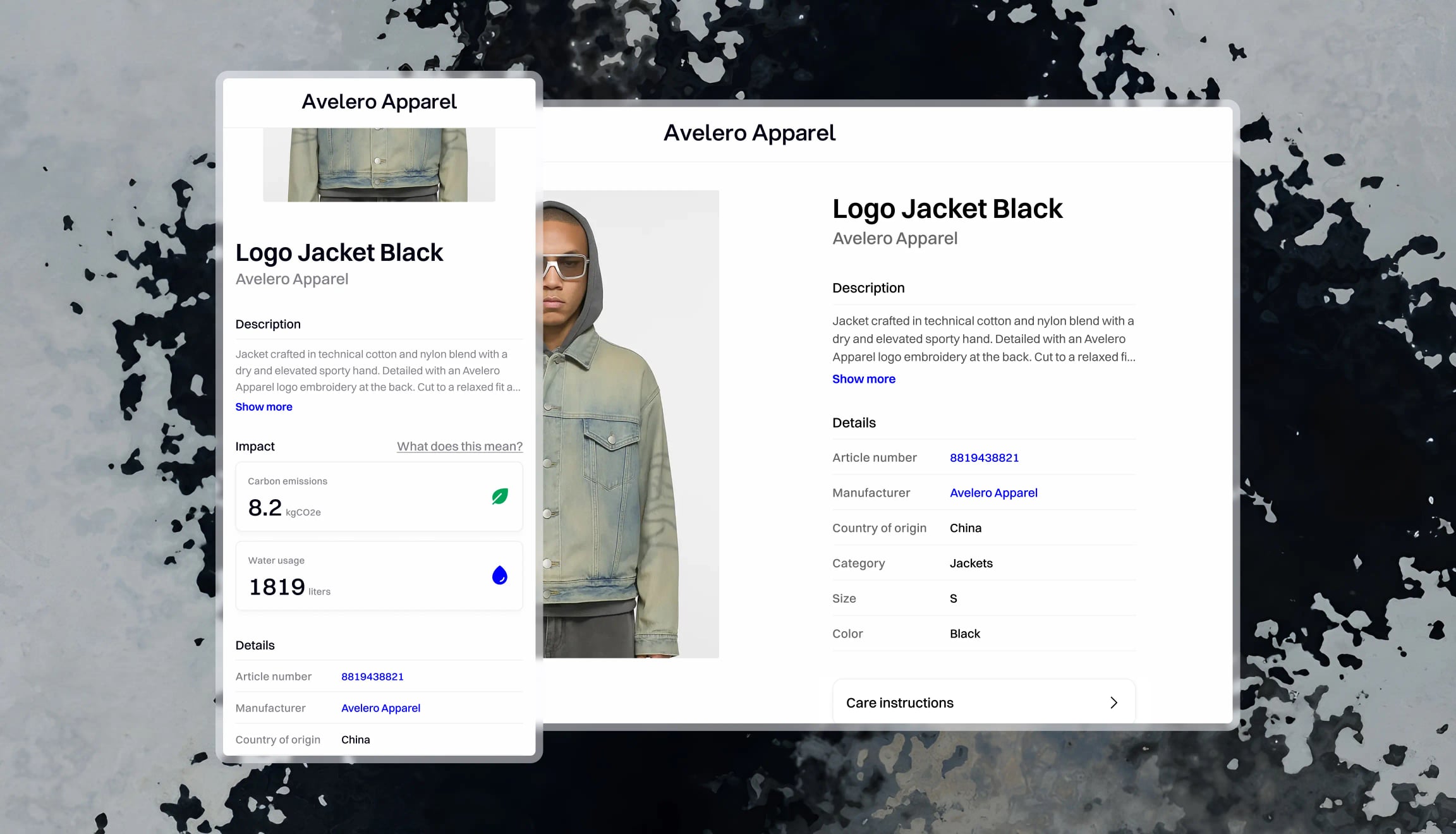
The DPP is the ESPR's most visible mechanism for fashion brands. It's a digital record attached to a product through a data carrier (most likely a QR code on the care label) that contains structured information about the product's materials, production, environmental impact, and end-of-life handling.
The ESPR establishes the DPP framework in Articles 9 through 12. DPP data must be machine-readable, searchable, and based on open, interoperable standards. It must be retained for at least the product's expected lifetime. And DPP service providers are explicitly prohibited from selling the data they host, which is a meaningful protection for brands concerned about data ownership.
Three access tiers govern who can see what. Consumers get general product information, sustainability data, and care instructions. Business-to-business users (like repair services or recyclers) get detailed composition and technical data. Regulators and customs authorities get the full picture, including compliance documentation and substance data.
A central EU DPP registry must be operational by 19 July 2026. Every product subject to a DPP requirement will need to be registered before being placed on the market. If a company ceases operations, its DPP data must be transferred to the Commission-maintained registry.
On the technical side, the EU is building around GS1 standards for product identification and data carriers. The GS1 Digital Link, which encodes your product's barcode number (GTIN) into a URL structure that can be embedded in a QR code, has emerged as the dominant approach. It works as both a consumer-facing link to the passport and a machine-readable product identifier. We've written a detailed explainer on how this works and why it matters for vendor independence.
The exact data fields for each product group will be defined in the respective delegated acts. For textiles, the expected requirements cover material composition, supply chain traceability, substances of concern, durability and repairability information, care instructions, lifecycle environmental impacts, recycled content, recyclability, and certifications. We've broken these down in our full guide to DPP data requirements.
Who it applies to#
The ESPR imposes obligations across the entire value chain.
Manufacturers bear the heaviest burden. They must ensure products comply with applicable delegated acts, carry out conformity assessments, prepare technical documentation, issue an EU Declaration of Conformity, affix the CE marking, and ensure the DPP is available.
Importers must verify that manufacturers have completed conformity assessments, ensure DPP availability, and display their own name and contact details on products. Distributors must verify CE marking and documentation before making products available, and refuse to supply products they believe are non-compliant. If an importer or distributor places a product under their own brand, they take on full manufacturer obligations.
Online marketplaces must cooperate with market surveillance authorities, designate a contact point, and ensure product identification is available. This builds on the Digital Services Act.
For non-EU companies, the regulation applies in a non-discriminatory manner. If you sell into the EU market, your products must comply regardless of where your company is headquartered. In practice, the EU-based importer bears primary responsibility for ensuring compliance. Non-EU manufacturers can also appoint an authorized representative established in the EU.
Size-based exemptions exist but are limited. Micro and small enterprises are exempt from the destruction ban indefinitely, and the Commission is required to provide digital tools and guidelines for SMEs to reduce administrative burden. Delegated acts for specific product groups may include additional transitional measures for smaller companies.
Enforcement is handled by national market surveillance authorities, with customs authorities able to refuse entry to non-compliant products at EU borders. Penalties are set by member states but must be effective and dissuasive. The ESPR also introduces a private enforcement mechanism: consumers have the right to claim compensation for damage from non-compliant products.
How the ESPR connects to other EU regulations#
The ESPR doesn't operate in isolation. It's part of a broader regulatory push, and understanding the connections matters for compliance planning.
The Empowering Consumers Directive, applicable from September 2026, bans generic green claims like "eco-friendly" or "climate neutral" unless backed by verifiable data. The ESPR's DPPs provide exactly that kind of verified data infrastructure. The two regulations are designed to work together: the ESPR structures what product data must exist, and the Empowering Consumers Directive regulates how sustainability attributes can be communicated to consumers.
The Forced Labour Regulation, applicable from December 2027, makes supply chain traceability a market access requirement independent of the DPP. The supply chain origin data tracked in DPPs will be directly relevant for demonstrating that products were not made with forced labour.
The interaction with REACH is worth understanding. REACH regulates chemical substances in terms of their manufacture, import, and use. The ESPR's substances of concern definition is broader and focused on final products and their circularity impact. The DPP will effectively digitize and systematize the substance disclosure that REACH's Article 33 already requires for SVHCs above 0.1% concentration, while also enabling new restrictions through delegated acts.
Social sustainability aspects, such as labour conditions, were deliberately excluded from the ESPR's scope for now. A Commission report evaluating their potential inclusion is due by July 2028. In the interim, social due diligence remains under the CSDDD.
The Omnibus left the ESPR untouched#
This point keeps coming up, so it's worth addressing directly. In 2025, the EU's Omnibus simplification package significantly scaled back corporate sustainability obligations. The CSRD reporting threshold was raised to 1,000+ employees, eliminating over 80% of originally scoped companies. The CSDDD saw its application delayed and thresholds raised.
But the ESPR was not part of any Omnibus package. The regulation, including its DPP framework, was left entirely intact. This makes sense when you look at what the Omnibus targeted: corporate-level reporting obligations. The ESPR operates at the product level, which is a fundamentally different mechanism. DPPs are product data management tools, not annual sustainability reports. The Commission has consistently framed the ESPR as reducing raw material dependencies and strengthening industrial competitiveness through circularity, which aligns with the simplification agenda rather than contradicting it.
Throughout 2025 and into 2026, the Commission adopted multiple Omnibus packages across various sectors, including an Environmental Omnibus in December 2025. None targeted ESPR core provisions.
What happens next#
The coming months are critical for implementation. Here's what to watch.
July 2026: The central EU DPP registry must be operational. The ban on destruction of unsold textiles and footwear takes effect for large enterprises. Disclosure obligations for discarded unsold products are already in effect since July 2025.
September 2026: The Empowering Consumers Directive kicks in, prohibiting generic green claims without verifiable data.
Late 2026 to Q2 2027: The textile delegated act is expected to be adopted. This is the instrument that defines the exact data fields for textile DPPs and the specific ecodesign performance requirements for garments.
December 2027: The Forced Labour Regulation becomes fully applicable, making supply chain traceability a market access requirement.
~Mid-2028: Based on 18 months after the expected delegated act adoption, this is when mandatory DPPs for new textile products would take effect.
2028: Mid-term review of the Working Plan, potentially adding new product groups.
These dates may shift as the regulatory process progresses, but the trajectory is clear and the obligations will only get broader over time. For a detailed breakdown of every confirmed and expected date, see our full timeline.
What this means for fashion brands#
If you're a fashion brand selling into the EU, the ESPR is the regulation that everything else connects to. The DPP, the destruction ban, the substance disclosure requirements, the upcoming environmental footprint obligations: they all flow from this framework.
The delegated act will finalize the exact requirements, but the direction is clear enough to start now. The most practical step is to run a small pilot: pick a handful of products, map the data you already have, and generate test passports. This surfaces gaps, particularly around supply chain traceability and lifecycle environmental data, that take time to fill.
You don't need to solve everything at once. Start with what's accessible: material compositions, supplier information, certifications, care instructions. Then work backward through the harder requirements. The goal is to have your data infrastructure in order so that when the delegated act drops, you're filling in fields rather than building a system from scratch.
If you're not sure where to begin on the data side, we've written a detailed breakdown of the expected data requirements for the textile DPP. And if you're evaluating tools, our comparison of the main DPP platforms covers what to look for and how the options differ.
We built Avelero to make this fast. You can connect your product data, customize the passport to match your brand, and start generating QR codes in days rather than months. If you want to see how it works, we'd like to show you.